Protecting Research Data Against Theft and Exposure
Introduction
Research data is one of the most valuable assets within educational institutions. Universities, colleges, laboratories, and research organizations collect and manage large volumes of information, including experimental results, survey responses, student records, intellectual property, unpublished findings, and sensitive participant information.
As research becomes increasingly digital and collaborative, this information may be stored across institutional servers, cloud platforms, research applications, personal devices, and third-party services. This creates multiple points where unauthorized access, accidental exposure, data theft, or loss can occur.
A structured https://www.rashicore.com/education.php security approach can help educational organizations protect research information while maintaining the accessibility and collaboration required for academic work.
Why Research Data Needs Strong Protection
Research data can contain information that is valuable to researchers, institutions, commercial partners, and unauthorized individuals. A breach can affect confidentiality, research integrity, intellectual property, and the privacy of research participants.
The National Institute of Standards and Technology (NIST) notes that research environments have unique cybersecurity considerations because higher-education research is often collaborative and decentralized.
Protecting research data therefore requires more than securing a single database. Institutions need to consider how data is collected, stored, processed, shared, preserved, and eventually deleted.
Common Risks to Research Data
Unauthorized Access
Weak passwords, compromised accounts, excessive privileges, or poorly protected systems can allow unauthorized users to access research information.
Access should be based on legitimate responsibilities, with users receiving only the permissions required to perform their work.
Phishing and Credential Theft
Researchers and academic staff may receive targeted emails containing malicious links or fake login pages. If credentials are compromised, attackers may use legitimate accounts to access research systems.
Multi-factor authentication, security awareness training, and monitoring can help reduce these risks.
Cloud Data Exposure
Cloud platforms can simplify research collaboration but may introduce risks when storage permissions are incorrectly configured.
Institutions should review cloud access permissions regularly and ensure that sensitive research files are not unintentionally exposed to unauthorized users.
Protect Research Data Throughout Its Lifecycle
NIST's Research Data Framework organizes research data activities across stages including planning, generation or acquisition, processing and analysis, sharing and reuse, and preservation or disposal.
Data Collection
Before collecting information, researchers should understand what data is necessary and classify sensitive information appropriately.
Where personal or confidential information is involved, institutions should establish appropriate privacy and security requirements before collection begins.
Data Storage
Research datasets should be stored in approved and secured environments. Access should be restricted according to roles and responsibilities.
Sensitive information should also be protected through appropriate encryption and backup controls.
Data Processing
Researchers should ensure that applications, databases, and analytical environments are properly secured.
Access logs and monitoring can help institutions identify unusual activity and investigate potential security incidents.
Data Sharing
Research collaboration should not mean unrestricted access.
Organizations should establish controlled mechanisms for sharing research datasets and review third-party access carefully. Where possible, sensitive information should be minimized or de-identified before it is shared.
The U.S. Department of Education provides resources for researchers concerning disclosure avoidance, de-identification, and suppression of personally identifiable information in education records.
Data Retention and Disposal
Not every dataset needs to be retained indefinitely. Organizations should define appropriate retention periods and securely dispose of information when it is no longer required.
The U.S. Department of Education identifies data retention and destruction as important elements of education-data governance and security practices.
Protecting Research Data in Collaborative Environments
Modern research frequently involves collaboration between departments, universities, laboratories, government organizations, and private-sector partners.
While collaboration can accelerate research, it also creates additional access points. NIST's research-security resources emphasize risk-based approaches for protecting research and intellectual property while maintaining legitimate collaboration.
Organizations should establish clear requirements for:
- Who can access research data
- Which datasets can be shared
- How data should be transferred
- How external users are authenticated
- How third-party access is monitored
- When access should be removed
- How data should be returned or destroyed
Educational institutions can strengthen their overall security posture by incorporating structured cybersecurity practices into their technology and research environments. More information about securing education-sector systems is available through https://www.rashicore.com/education.php.
Conclusion
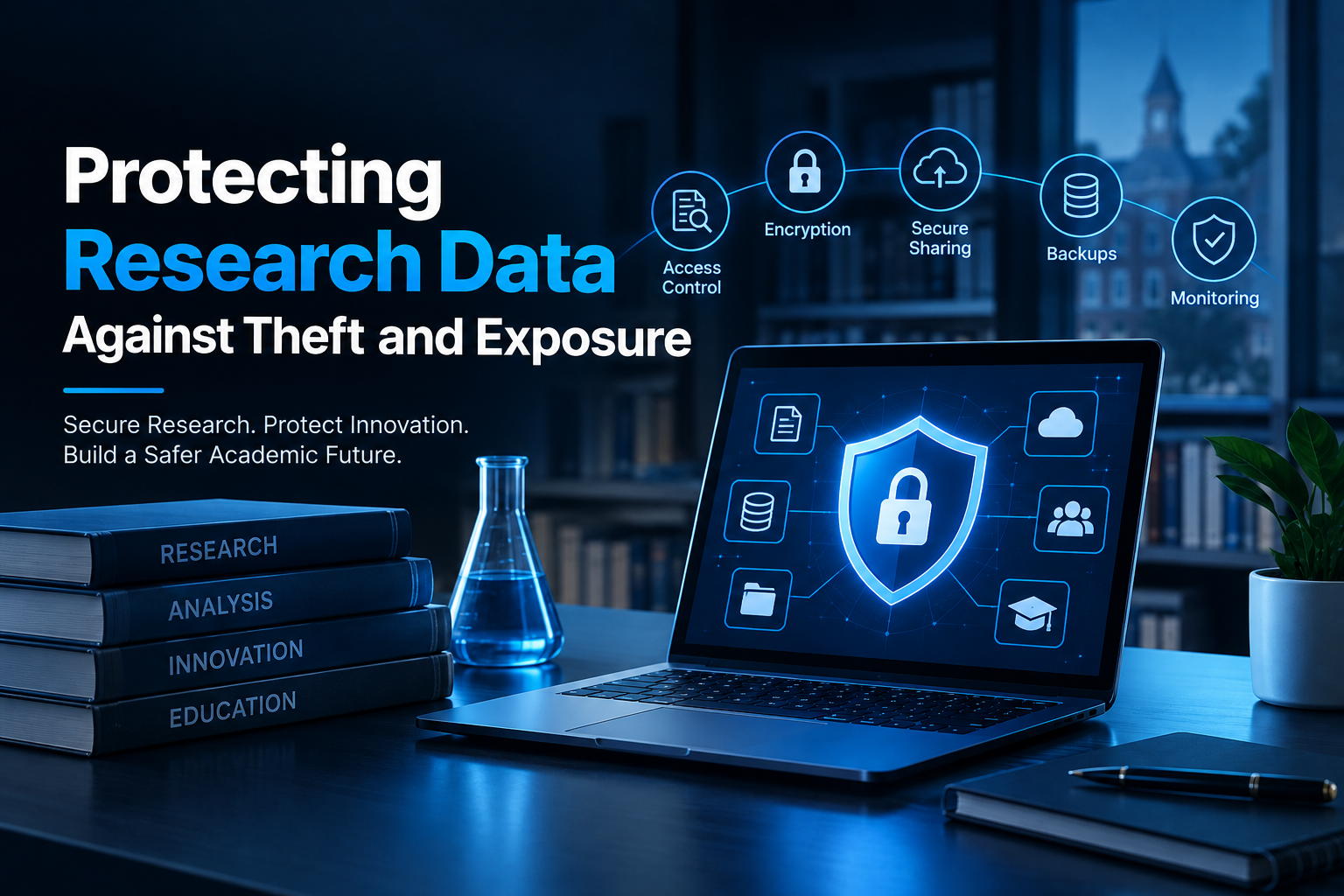
Research data protection requires a lifecycle-based approach that covers collection, storage, processing, sharing, preservation, and secure disposal. Strong access controls, encryption, multi-factor authentication, backups, monitoring, security awareness, and regular assessments can help reduce the risk of theft and accidental exposure.
Educational institutions should also consider the unique challenges of research environments, where open collaboration and decentralized systems can create additional security considerations. A structured https://www.rashicore.com/education.php approach to cybersecurity can help protect research information while supporting legitimate academic collaboration.
 UK
UK
 USA
USA
 UAE
UAE
 Canada
 Australia
 Germany
 Singapore
 Netherlands