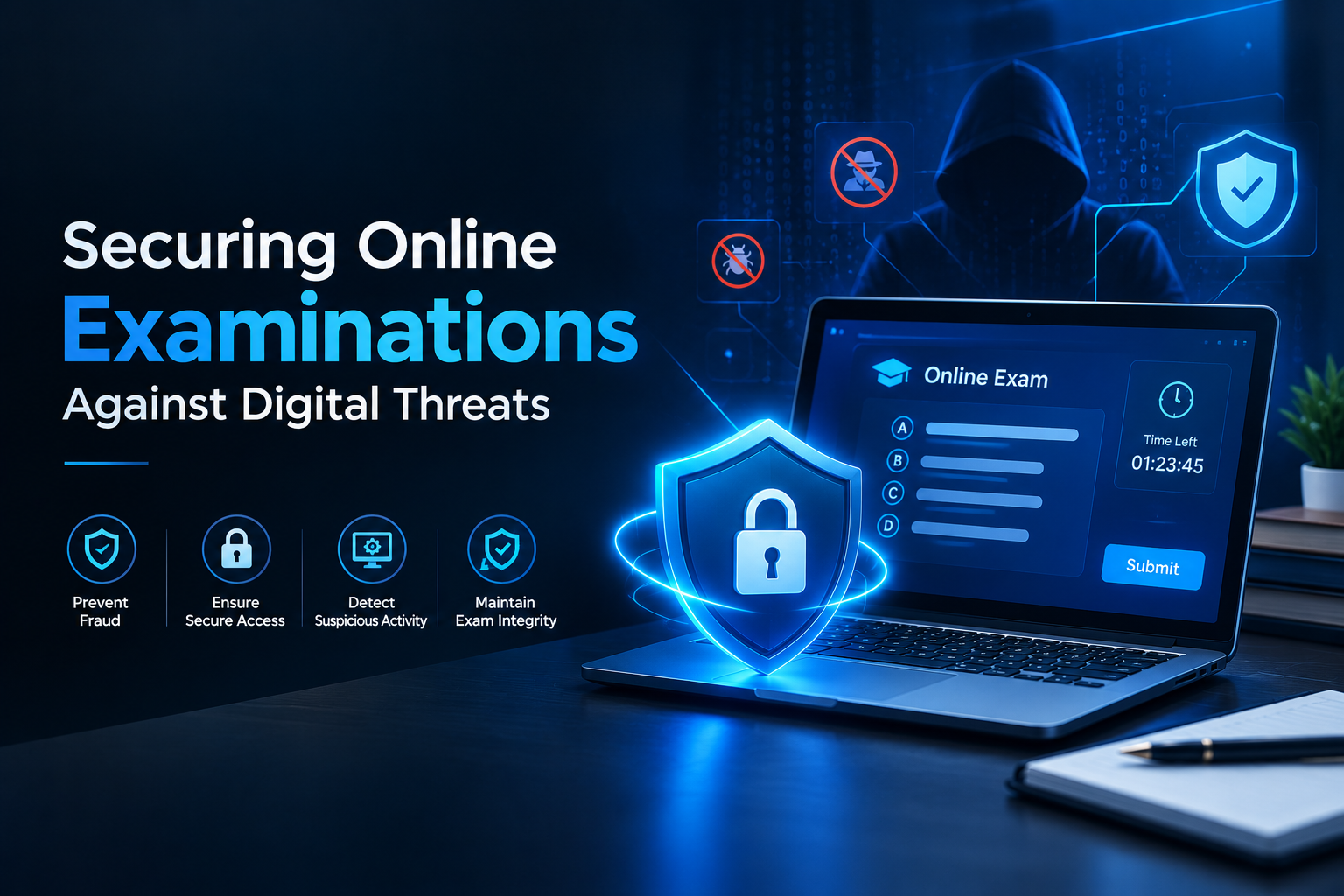
Securing Online Examinations Against Digital Threats
Online examinations have transformed how schools, colleges, universities, and professional institutions evaluate learners. They provide flexibility, scalability, and faster assessment, but they also introduce cybersecurity challenges. Research on online assessment security highlights threats such as impersonation, collusion, unauthorized access, content leakage, and other forms of academic misconduct.
As examination systems become increasingly digital, institutions need to protect not only the exam platform but also student identities, examination content, submitted answers, and assessment records.
Why Online Examinations Need Stronger Security
A digital examination platform handles sensitive information throughout the entire assessment lifecycle. This may include student registration details, login credentials, examination questions, answers, scores, recordings, and administrative data.
A security weakness at any stage can affect examination integrity. Current research and assessment-security guidance identify authentication, unauthorized access, malpractice prevention, secure data management, and platform reliability as important areas of concern.
Common Digital Threats to Online Examinations
1. Account Takeover and Impersonation
Weak passwords, credential sharing, phishing, or compromised accounts can allow an unauthorized person to access an examination. Impersonation is particularly important because the person completing an assessment may not be the registered candidate.
Institutions can reduce this risk through stronger authentication, controlled login sessions, multi-factor authentication, and appropriate identity verification.
2. Examination Content Leakage
Question papers and assessment materials are valuable information. Unauthorized access to question banks, screenshots, leaked credentials, or improperly secured databases can expose examination content before or during an assessment.
Using access controls, encryption, secure storage, and carefully managed permissions can help limit unnecessary exposure.
3. Malware and Phishing Attacks
Students, teachers, and examination administrators may become targets of phishing emails or malicious links. A compromised administrator account could potentially provide attackers with access to examination systems or sensitive data.
Security awareness training and strong authentication should therefore form part of an institution's digital examination security strategy.
4. Denial-of-Service Attacks
Online examinations depend on the availability of servers, networks, and application infrastructure. A disruption during a high-stakes examination can prevent students from accessing their assessments or submitting answers.
Institutions should consider infrastructure monitoring, capacity planning, backup connectivity, and incident-response procedures when preparing for large examination events.
Protecting Examination Data
Security should cover examination data from creation through storage, delivery, submission, evaluation, and archival.
Important measures include:
- Encryption during transmission and storage
- Role-based access controls
- Least-privilege permissions
- Secure database configuration
- Regular vulnerability assessments
- Audit logging
- Secure backups
- Controlled access to question banks
- Defined data-retention procedures
These controls can help institutions maintain confidentiality, integrity, and availability throughout the assessment lifecycle.
Secure Examination Platform Design
Security should also be incorporated into the design of the examination platform itself. A secure system should be regularly tested for vulnerabilities before being used for important assessments.
Application security testing can help identify weaknesses such as authentication flaws, insecure access controls, exposed data, injection vulnerabilities, and configuration problems.
Institutions can also use security monitoring to identify suspicious activity during and after examinations.
Regular Security Testing Is Essential
Cybersecurity should not be treated as a one-time activity before examination season. Examination platforms, authentication systems, APIs, databases, and supporting infrastructure can change over time.
Regular vulnerability assessments, penetration testing, access reviews, security monitoring, and backup/recovery testing can help institutions identify weaknesses before they affect an examination.
For institutions looking to strengthen their overall education-sector cybersecurity approach, Rashicore provides information about its Education security solutions here:
https://www.rashicore.com/education.php
Conclusion
Online examinations require security measures that cover the complete assessment lifecycle—from student authentication and examination-content protection to data storage, monitoring, submission, and recovery. A combination of secure technology, appropriate assessment design, regular security testing, and clear operational procedures can help educational institutions create more resilient digital assessment environments.
For more information about cybersecurity solutions for educational institutions, visit:
 UK
UK
 USA
USA
 UAE
UAE
 Canada
 Australia
 Germany
 Singapore
 Netherlands