
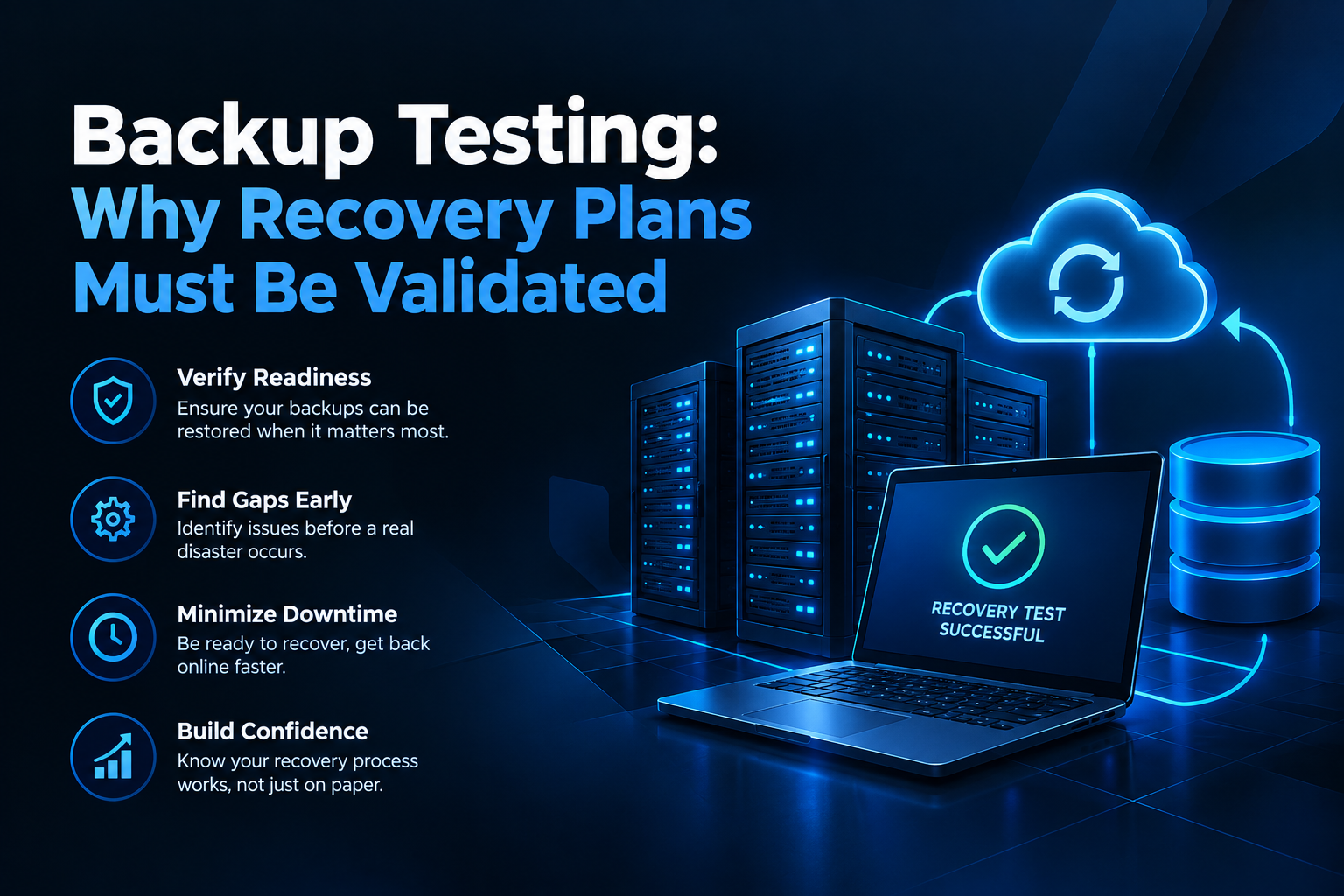
Backup Testing: Why Recovery Plans Must Be Validated
Introduction
A backup strategy can provide an important layer of protection against accidental deletion, system failures, cyber incidents, hardware problems, and other disruptions. However, creating backups does not automatically guarantee that an organization will be able to recover its data when it is needed.
The real question is not simply “Do we have backups?” but “Can we successfully restore from those backups?”
Backup testing provides a practical way to answer that question. By periodically restoring selected data, applications, or systems in a controlled environment, organizations can identify problems before an actual recovery event occurs.
CISA guidance emphasizes testing backup and storage procedures and using test results to identify improvements to continuity plans.
Why Backup Testing Matters
Backups can fail to provide effective recovery for several reasons. Files may be incomplete, backup jobs may have failed silently, credentials may no longer work, or recovery procedures may depend on systems that have changed since the backup was created.
Testing helps organizations move beyond simply storing backup copies and verify the complete recovery process.
A proper testing program can help determine:
- Whether backup data is accessible
- Whether files can be restored correctly
- Whether applications can be recovered
- Whether required credentials and permissions are available
- Whether recovery procedures are accurate
- Whether recovery can meet defined objectives
- Whether staff understand their recovery responsibilities
CISA's Cyber Resilience Review specifically recommends testing backup and storage procedures for high-value information assets and comparing test results against established objectives.
What Should Be Included in a Backup Test?
A backup test should reflect the organization's actual recovery requirements. Depending on the environment, testing can involve individual files, databases, applications, virtual machines, servers, or larger groups of systems.
1. File Restoration Testing
Start with individual files or folders to confirm that selected backup data can be located and restored successfully.
This can help identify problems with:
- File availability
- Backup retention
- Permissions
- Backup indexing
- Restoration procedures
2. Application Recovery Testing
For business-critical applications, restoring individual files may not be enough. Organizations should verify whether the application and its required dependencies can be brought back into operation.
3. System Recovery Testing
System-level testing can help determine whether servers, virtual machines, or other infrastructure components can be restored according to documented procedures.
4. Database Recovery Testing
Databases often require specific recovery procedures. Testing should verify that database backups can be restored and that the recovered data is usable.
5. Recovery Procedure Testing
The technical backup itself is only one part of recovery. Teams should also test the documented steps, communication procedures, access requirements, responsibilities, and escalation processes.
Test Recovery Against Defined Objectives
Recovery testing becomes more useful when organizations establish measurable objectives.
Two commonly used concepts are:
Recovery Point Objective (RPO):
The amount of data loss, measured in time, that an organization is prepared to accept.
Recovery Time Objective (RTO):
The target amount of time within which a system or service should be restored.
For example, if a critical application has a four-hour RTO, a recovery exercise can determine whether the documented process can realistically restore the application within that timeframe.
Testing can therefore reveal differences between planned recovery capabilities and actual recovery performance.
How to Build a Practical Backup Testing Process
Organizations can establish a structured testing cycle instead of treating recovery testing as a one-time exercise.
Step 1: Identify Critical Data and Systems
Determine which information assets and applications are essential to business operations.
Step 2: Define Recovery Requirements
Document appropriate recovery objectives, including acceptable recovery time and data-loss requirements.
Step 3: Select a Testing Method
Testing can range from individual file restoration to application recovery exercises or larger recovery simulations.
Step 4: Perform the Recovery Test
Restore selected data or systems in a controlled environment while following the documented recovery process.
Step 5: Record the Results
Document:
- What was tested
- Date of the test
- Backup source
- Restoration time
- Issues encountered
- Data successfully recovered
- Failed recovery steps
- Required corrective actions
Step 6: Improve the Recovery Plan
Test results should feed directly into improvements. CISA guidance notes that comparing test results with objectives can identify improvements to service continuity and recovery plans.
How Data Protection Supports Recovery Readiness
Backup testing should form part of a broader data protection strategy. Organizations need to consider how information is backed up, stored, protected, retained, restored, and reviewed.
A structured approach can include:
- Regular backup schedules
- Appropriate retention policies
- Secure backup storage
- Access controls
- Encryption where appropriate
- Backup monitoring
- Restoration testing
- Recovery documentation
- Periodic review of recovery requirements
CISA materials also describe the importance of testing backups and incorporating lessons from continuity exercises into future improvements.
For organizations reviewing their overall data protection practices, more information is available at:
https://www.rashicore.com/data-protection.php
Conclusion
Backup testing turns a backup strategy into a more measurable recovery capability. Instead of assuming that stored backup copies will work during an emergency, organizations can regularly validate restoration procedures, identify weaknesses, and improve recovery processes.
A reliable recovery strategy should therefore include not only backup creation and secure storage but also regular restoration testing, documented results, defined recovery objectives, and continuous improvement.
Organizations looking to strengthen their approach to data protection and recovery readiness can review:
https://www.rashicore.com/data-protection.php
Additional security and resilience considerations can be integrated with the organization's broader cybersecurity planning and recovery processes.
 UK
UK
 USA
USA
 UAE
UAE
 Canada
 Australia
 Germany
 Singapore
 Netherlands