
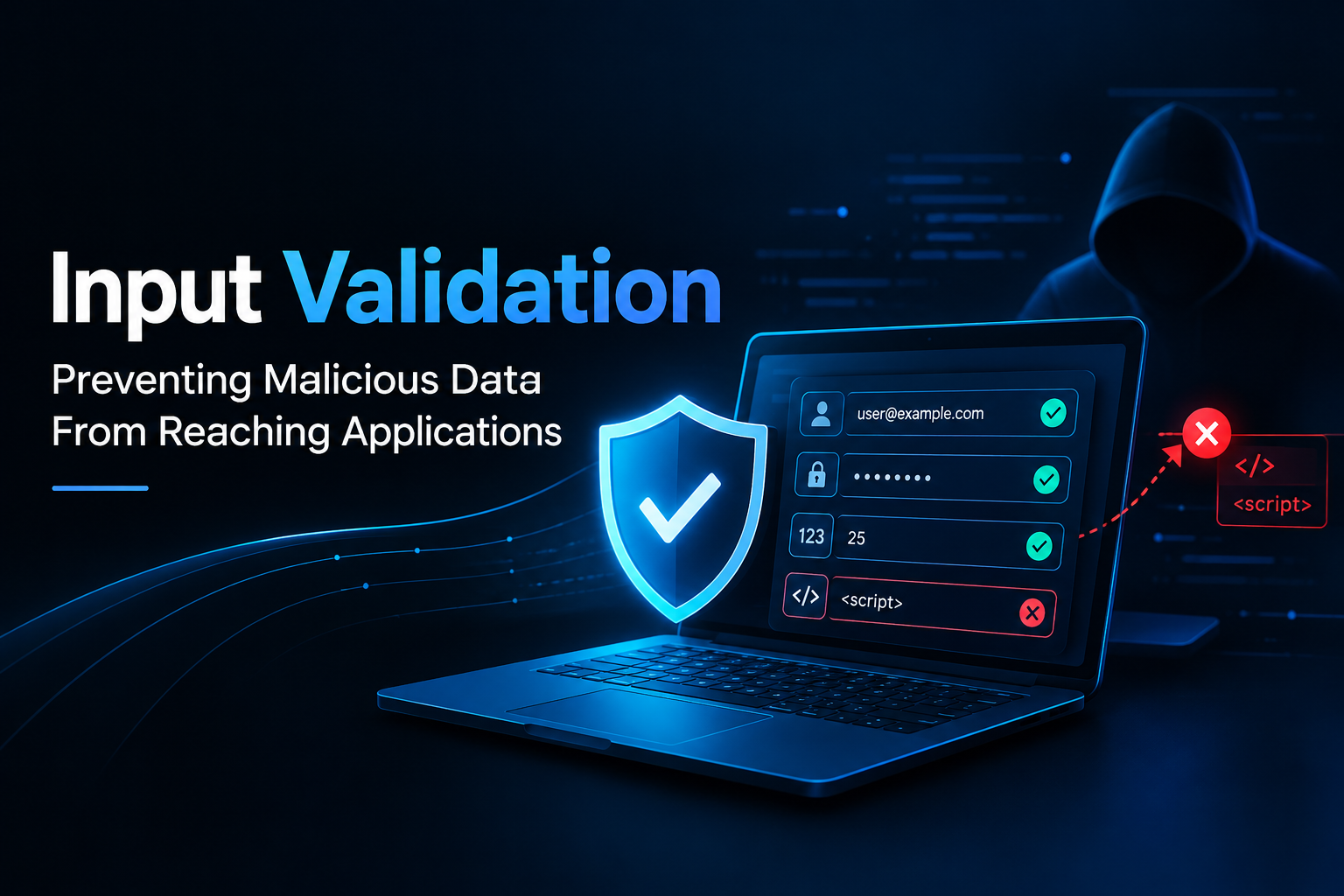
Input Validation: Preventing Malicious Data From Reaching Applications
Introduction
Web applications continuously receive data from users, APIs, browsers, third-party services, and other external systems. While much of this information is legitimate, attackers can also manipulate input fields, parameters, headers, file uploads, and API requests to introduce malicious or unexpected data.
Input validation helps applications determine whether incoming data matches the expected format, type, length, and business rules before it is processed. Effective validation should begin as early as possible and should be performed on the server because client-side validation can be bypassed.
For organizations handling sensitive information, combining strong validation practices with professional https://www.rashicore.com/web-application-security.php can help identify weaknesses before attackers exploit them.
What Is Input Validation?
Input validation is the process of checking incoming data against predefined requirements before allowing an application to process it.
For example, an application may expect:
- An email address to follow a valid format
- A phone number to contain an appropriate number of digits
- A quantity to be within an acceptable range
- A date to follow the expected format
- A username to remain within a defined character and length limit
- An uploaded file to match an approved file type and size
Validation should consider both syntax and meaning. A value can have the correct format but still be invalid in the application's business context. OWASP recommends validating both syntactic and semantic correctness.
Why Malicious Input Is a Security Risk
Applications often pass user-controlled data through multiple components such as databases, APIs, operating-system functions, templates, and third-party services. If unexpected input reaches these components without appropriate controls, it may contribute to vulnerabilities such as:
- SQL injection
- Cross-site scripting (XSS)
- Command injection
- Path traversal
- Malicious file uploads
- Business logic abuse
- Denial-of-service conditions
- Unexpected application behavior
Common Input Validation Techniques
1. Use Allowlist Validation
Allowlist validation defines what data is permitted instead of attempting to identify every possible malicious pattern.
For example, if a field should contain only numeric values, the application should explicitly accept the required numeric format and reject unexpected values.
OWASP recommends allowlisting whenever practical because attackers can often bypass simple denylist filters.
2. Validate Data Types
Applications should confirm that incoming values have the expected data type.
A field designed to receive an integer should not accept arbitrary strings. Similarly, boolean, date, currency, and enumerated values should be validated according to their expected types.
Strong typing can provide an additional layer of protection for APIs and application parameters.
3. Apply Length and Range Restrictions
Every input field should have reasonable limits.
For example:
- Username: defined minimum and maximum length
- Comment: maximum character limit
- Quantity: minimum and maximum acceptable value
- File upload: maximum permitted size
- API request: maximum request body size
These controls help prevent unexpected data from reaching application components and can also reduce certain resource-exhaustion risks.
4. Perform Server-Side Validation
Client-side JavaScript validation can improve user experience, but it should never be the only security control.
An attacker can modify requests, disable JavaScript, or use a proxy to send data directly to the server. Therefore, important validation rules must be enforced on the server before the application processes the data.
Organizations can also use https://www.rashicore.com/web-application-security.php to assess application security controls and identify weaknesses that may allow unsafe data to reach sensitive application functions.
Input Validation for APIs
Modern applications frequently exchange information through APIs. API endpoints should treat incoming parameters and objects as untrusted until they have been validated.
Important checks include:
- Data type
- Format
- Length
- Numeric range
- Allowed values
- Request size
- Content type
- Business rules
Input Validation and Business Logic
Security validation should go beyond checking whether data looks technically correct.
For example, a discount value may be a valid number but still exceed the maximum discount allowed by the business. Likewise, two individually valid dates may form an invalid booking period when combined.
Semantic validation checks whether input makes sense within the application's business rules.
How Secure Development Teams Can Improve Validation
A secure development approach should include validation throughout the application lifecycle.
Development teams can:
- Identify every external input source.
- Classify inputs as trusted or untrusted.
- Define expected formats and data types.
- Use allowlists wherever practical.
- Apply length and range restrictions.
- Enforce validation on the server.
- Validate file uploads separately.
- Apply business-rule validation.
- Use parameterized database queries.
- Apply context-specific output encoding.
Security testing can help uncover validation weaknesses that may not be visible during normal application testing. A dedicated https://www.rashicore.com/web-application-security.php assessment can support organizations in identifying application-level security gaps and improving defensive controls.
Conclusion
Input validation is a fundamental part of secure web application development. By controlling the type, format, length, range, and business meaning of incoming data, organizations can reduce the opportunity for malicious or unexpected information to reach sensitive application functions.
However, validation should work as part of a broader security strategy. Server-side validation, secure database practices, output encoding, file-upload controls, authentication security, and regular application security testing should work together to create stronger protection.
Transform Your Application Security
Strengthen your application security approach with structured testing, vulnerability identification, secure development practices, and remediation guidance. Explore https://www.rashicore.com/web-application-security.php to learn more about web application security solutions.
 UK
UK
 USA
USA
 UAE
UAE
 Canada
 Australia
 Germany
 Singapore
 Netherlands