Session Security: Reducing Risks From Hijacked User Sessions
Modern web applications rely on user sessions to keep people authenticated while they move between pages, access accounts, and perform different actions. Once a user successfully logs in, the application generally creates a session that identifies and maintains that authenticated state.
However, if a session is stolen or improperly managed, an attacker may be able to use the valid session to access an account without knowing the user's password. This makes session security an important part of protecting web applications and sensitive user information.
What Is Session Hijacking?
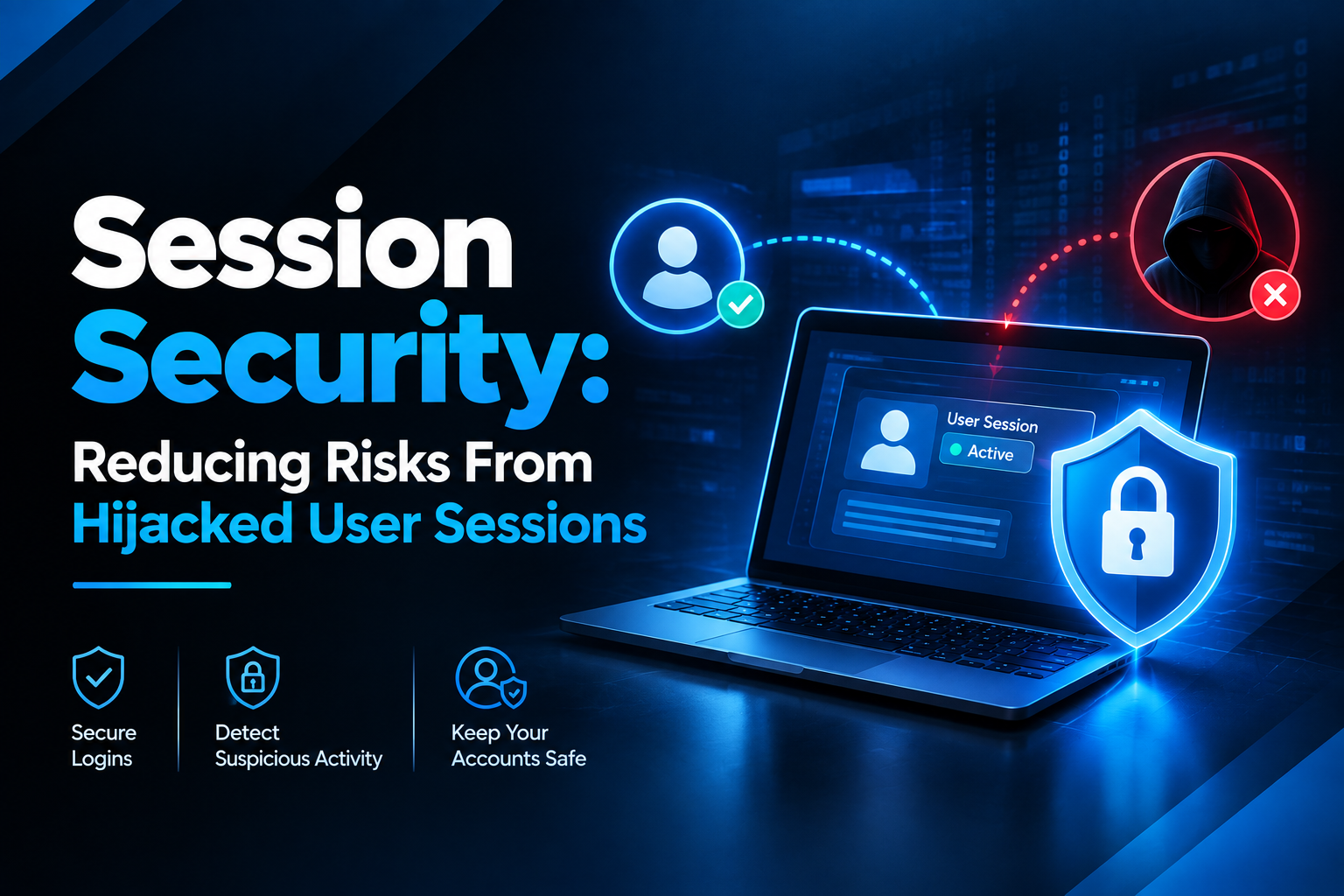
Session hijacking occurs when an attacker obtains or takes control of a valid user session. Instead of directly breaking the user's password, the attacker attempts to reuse the session identifier or authentication information associated with the legitimate user.
Depending on the privileges of the compromised account, this could allow unauthorized access to:
- User profiles
- Customer information
- Account settings
- Business applications
- Financial information
- Administrative functions
- Internal resources
Strong session management can help reduce the likelihood and impact of these attacks.
How User Sessions Can Be Compromised
Several security weaknesses can increase the risk of session hijacking.
1. Exposed Session Cookies
Session cookies contain information that can help a browser maintain an authenticated session. If these cookies are exposed through insecure communication, malicious scripts, or other vulnerabilities, attackers may attempt to reuse them.
Applications should use secure cookie configurations and protect session identifiers from unnecessary exposure.
2. Missing HTTPS Protection
Transmitting authentication information or session data over insecure connections can increase the risk of interception.
HTTPS should be consistently implemented across authenticated areas of a web application so that sensitive communication is encrypted during transmission.
3. Weak Session Cookie Settings
Cookie attributes play an important role in session security. Applications should appropriately configure attributes such as:
- Secure
- HttpOnly
- SameSite
These controls can help reduce certain risks involving session theft, unauthorized cookie access, and cross-site request scenarios.
Reauthentication for Sensitive Actions
Not every action should necessarily rely on an existing session alone.
For sensitive operations such as changing passwords, modifying account recovery information, changing payment details, or performing administrative actions, applications can require additional authentication or reauthentication.
This creates another security barrier if an active session has been compromised.
Session Security and Web Application Protection
Session management should be treated as part of the overall application security lifecycle rather than as an isolated authentication feature.
A broader security review can examine authentication mechanisms, session handling, authorization controls, application logic, and common web vulnerabilities.
Rashicore's Web Application Security services cover areas such as application security testing, source code analysis, Secure SDLC implementation, and vulnerability remediation. https://www.rashicore.com/web-application-security.php
Monitoring Suspicious Session Activity
Session security does not end after implementing technical controls. Monitoring can help organizations identify unusual activity that may indicate compromised accounts or sessions.
Potential indicators can include:
- Sudden changes in geographic access patterns
- Multiple simultaneous sessions
- Unusual device activity
- Abnormal account behavior
- Repeated authentication anomalies
- Access to sensitive functions outside normal patterns
Security teams can use application logs and authentication monitoring to investigate suspicious activity.
For organizations looking to identify weaknesses in application authentication and session handling, security testing can provide useful visibility into potential vulnerabilities. https://www.rashicore.com/web-application-security.php
Why Session Security Matters for Businesses
A compromised session can sometimes bypass the need for an attacker to repeatedly authenticate with a password. If the affected account has significant privileges, the consequences may extend beyond a single user.
Businesses should therefore consider session management as part of their broader web application security strategy.
Application security assessments can help evaluate authentication, session handling, authorization, and other controls that protect application users and business data. https://www.rashicore.com/web-application-security.php
Conclusion
User sessions provide an essential mechanism for maintaining authenticated access in modern web applications, but poorly managed sessions can create opportunities for unauthorized access. Session hijacking, fixation, exposed cookies, weak timeouts, and inadequate reauthentication controls can all increase security risks.
Organizations can strengthen session protection by combining secure cookie configurations, HTTPS, session regeneration, appropriate expiration policies, reauthentication, monitoring, and regular application security testing.
A structured Web Application Security approach can help businesses identify weaknesses in authentication and session management before they become more serious security incidents. More information is available at https://www.rashicore.com/web-application-security.php
 UK
UK
 USA
USA
 UAE
UAE
 Canada
 Australia
 Germany
 Singapore
 Netherlands