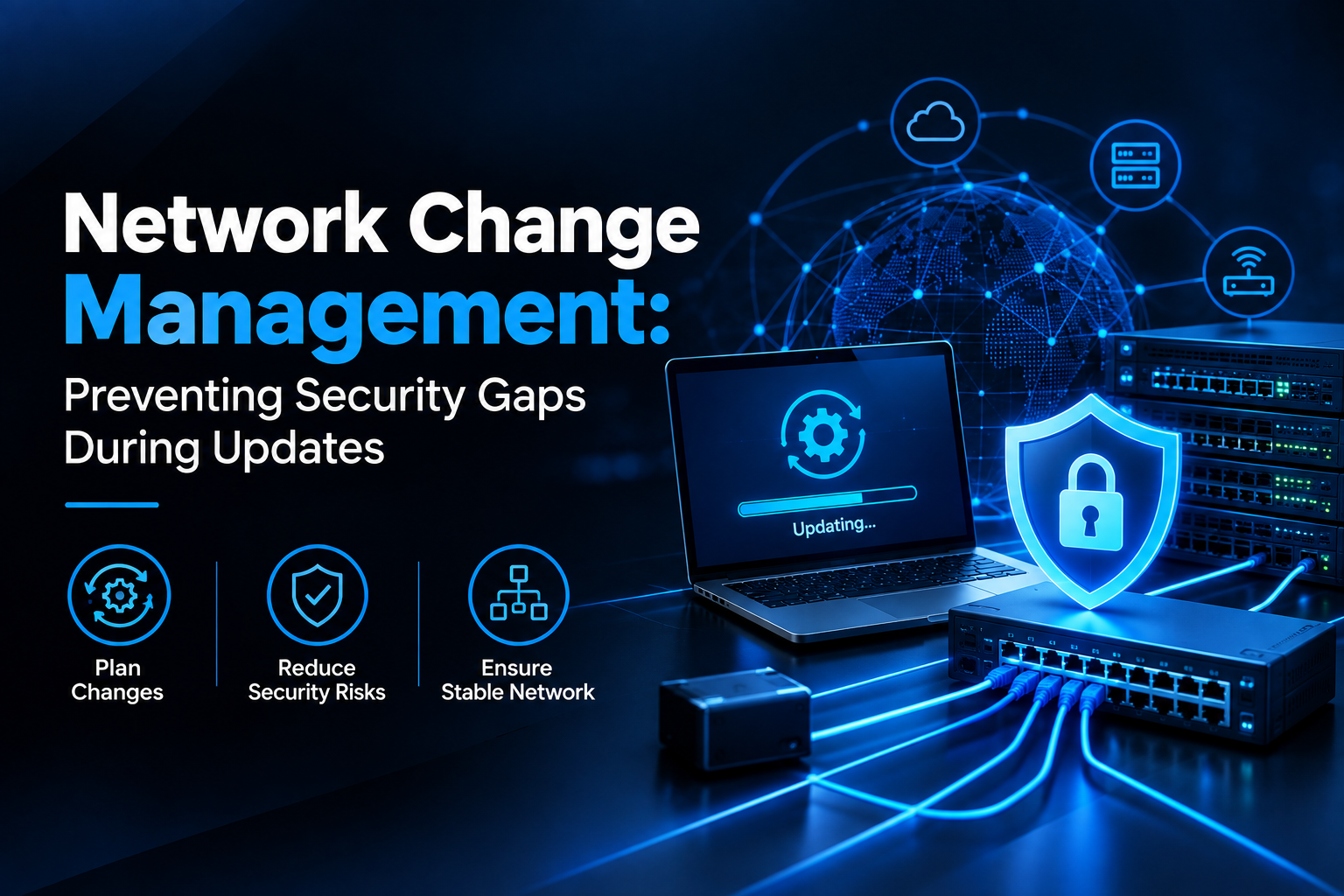
Network Change Management: Preventing Security Gaps During Updates
Introduction
Network infrastructure is constantly changing. Organizations update routers, switches, firewalls, access controls, operating systems, security policies, and network services to improve performance, support new applications, and address vulnerabilities.
NIST's security-focused configuration management guidance emphasizes integrating security considerations into configuration and change management so that system changes do not unintentionally weaken security.
For organizations looking to strengthen their network security practices, https://www.rashicore.com/networksecurity.php can provide additional information about protecting network infrastructure.
What Is Network Change Management?
Network change management is a structured process for controlling modifications to network infrastructure.
It generally involves:
- Identifying the requested change
- Assessing security and operational impact
- Reviewing dependencies
- Obtaining appropriate approval
- Testing the change
- Implementing the approved update
- Monitoring the environment afterward
- Documenting the final configuration
The purpose is not to prevent necessary changes. Instead, it is to make sure changes are introduced in a controlled and traceable manner.
Why Network Updates Can Create Security Gaps
Even legitimate updates can introduce unexpected security problems.
1. Firewall Rule Changes
Adding, removing, or modifying firewall rules can unintentionally allow unnecessary traffic or expose internal services.
Every firewall change should therefore be reviewed against the intended business requirement and existing security policies.
2. Configuration Drift
The configuration running on a device can gradually become different from the approved baseline.
Without regular comparison and monitoring, unauthorized or accidental modifications may remain unnoticed.
3. Access Control Changes
Updates involving administrator accounts, authentication systems, ACLs, VPNs, or network segmentation can change who can access critical resources.
Access changes should be reviewed before deployment and validated afterward.
4. Routing and Network Path Changes
Routing updates can affect how systems communicate with internal and external resources.
A change that appears operationally simple may create an unexpected communication path or bypass an existing security control.
5. Software and Firmware Updates
Updates can fix vulnerabilities but may also change functionality or configuration behavior.
NIST notes that software updates and patches can introduce cybersecurity and operational risks if they are not managed effectively.
Protecting Against Unauthorized Configuration Changes
Change management should also help identify changes that were never approved.
CISA recommends monitoring configuration modifications to network devices such as switches, routers, and firewalls outside the established change-management process.
Organizations can strengthen this process by:
- Centralizing configuration management
- Maintaining configuration history
- Comparing approved and active configurations
- Monitoring administrative activity
- Alerting on unexpected changes
- Reviewing firewall rule modifications
- Conducting periodic configuration audits
For broader network protection practices, organizations can also review https://www.rashicore.com/networksecurity.php.
Building a More Secure Change Process
A practical network change-management workflow can follow this sequence:
Request → Risk Assessment → Security Review → Testing → Approval → Implementation → Validation → Monitoring → Documentation
This approach creates a clear connection between operational changes and security requirements.
Organizations can also automate configuration comparisons and change detection where appropriate. NIST's 2026 guidance on security configuration checklists highlights the value of identifying unauthorized configuration changes and verifying secure configurations.
Conclusion
Network changes are an essential part of maintaining modern infrastructure, but they should not be treated as purely operational activities. Updates to firewalls, routers, switches, access controls, and software can influence the security posture of the entire environment.
A structured change-management process helps organizations assess risks, maintain configuration baselines, test updates, obtain approval, validate implementations, and monitor for unexpected changes.
For organizations strengthening their network protection strategy, https://www.rashicore.com/networksecurity.php can be reviewed alongside broader network security planning.
 UK
UK
 USA
USA
 UAE
UAE
 Canada
 Australia
 Germany
 Singapore
 Netherlands