
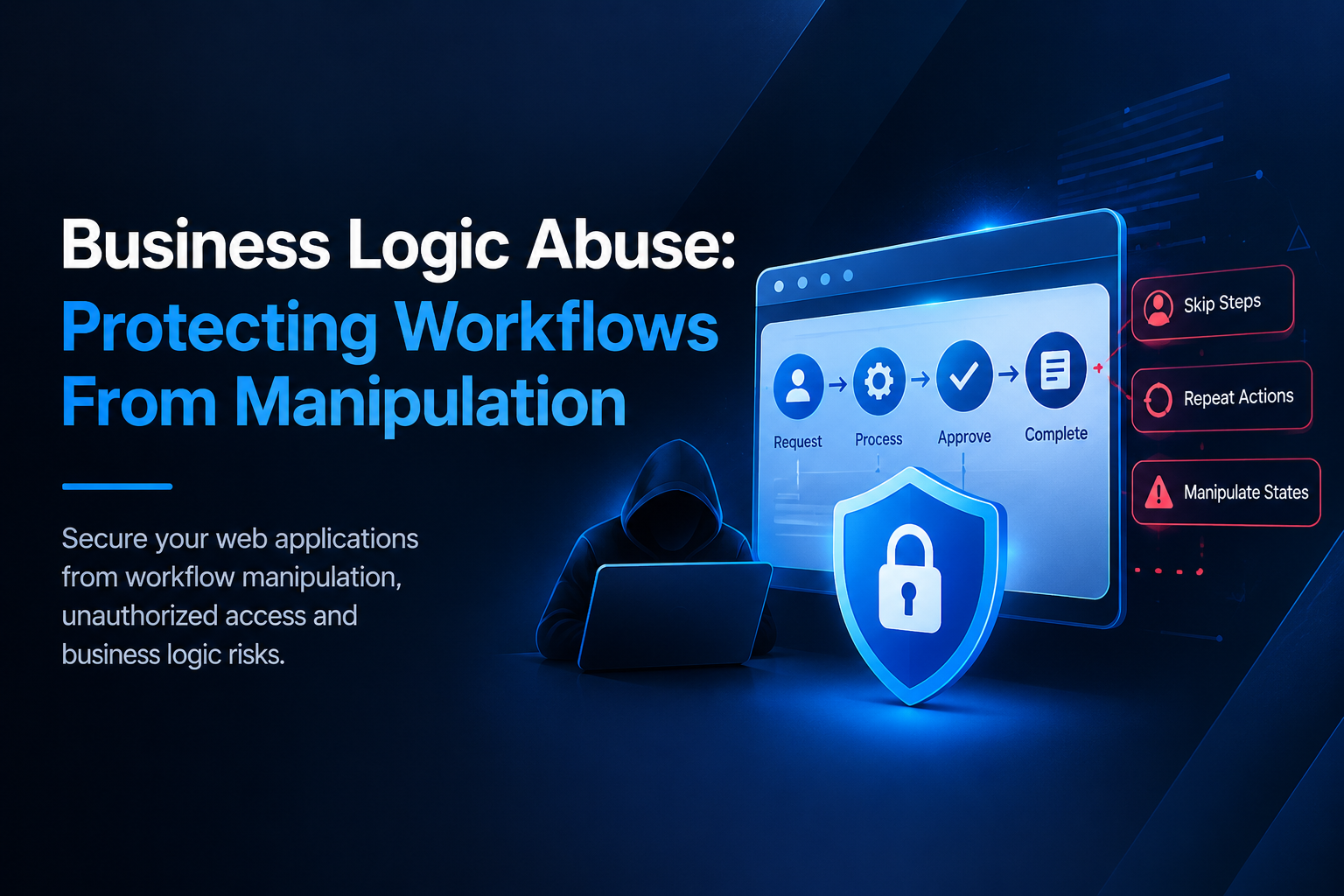
Business Logic Abuse: Protecting Workflows From Manipulation
Modern web applications are built around business processes. A customer may create an account, verify an identity, add products to a cart, complete payment and receive an order confirmation. Similarly, employees may submit requests that require multiple approvals before an action is completed.
For organizations looking to strengthen their application security posture, business logic protection should be considered alongside authentication, authorization and other technical security controls.
You can learn more about application protection and security testing at:
https://www.rashicore.com/web-application-security.php
What Is Business Logic Abuse?
Business logic abuse occurs when an application's legitimate functions can be used in ways that violate the rules of the underlying business process.
The application may technically accept the request because the endpoint, parameter or action is valid. The problem is that the request does not make sense according to the business rules.
OWASP's Web Security Testing Guide identifies workflow circumvention as a business-logic testing area because applications should enforce required steps and their correct order.
Why Business Logic Abuse Is Different From Traditional Vulnerabilities
Traditional web vulnerabilities often have recognizable technical patterns. Business logic weaknesses can be more difficult to identify because the application may be processing technically valid requests.
The issue is the relationship between different actions.
For example, an individual request might look normal, but performing several legitimate actions in an unexpected sequence could produce an unauthorized result.
This means security teams need to understand:
- What the application is designed to do
- Which actions depend on previous actions
- Which users can perform each action
- What conditions must be satisfied
- Which states an object can enter
- Which transitions should be prohibited
OWASP notes that business logic flaws can be difficult for automated tools to identify because they depend heavily on application-specific workflows and business rules.
Common Examples of Workflow Manipulation
Skipping Required Steps
A multi-step process may require users to complete several stages before reaching a final action.
If the server does not verify the current workflow state, a user could attempt to access a later stage without completing its prerequisites.
For example:
Registration → Verification → Approval → Activation
The application should not assume that reaching the activation page means the previous stages were completed.
Repeating Restricted Actions
Some actions are intended to happen only once.
Examples include:
- One-time promotional benefits
- Single-use verification actions
- Refund processing
- Account credits
- Approval decisions
If the application does not properly track state, the same action could potentially be repeated.
Manipulating Object State
Applications frequently store information about the state of an object, such as:
- Pending
- Approved
- Rejected
- Completed
- Cancelled
Security problems can occur when protected state information is accepted directly from an untrusted client without proper server-side validation.
OWASP's Business Logic Abuse guidance specifically discusses object-state manipulation as a business-logic risk.
Circumventing Approval Processes
Business applications often use approval workflows.
For example:
Employee Request → Manager Review → Finance Approval → Completion
Each stage should be validated independently. The application should not rely on the user interface to prevent someone from directly attempting to access the final stage.
Exploiting Concurrent Requests
Applications may also face problems when multiple requests are processed simultaneously.
For example, a resource intended to be used once may receive two requests at nearly the same time. If the system checks availability and processes the action without proper synchronization, both requests might succeed.
OWASP's current Business Logic Abuse Top 10 includes concurrent workflow-order bypass and action-limit overrun as specific business-logic abuse categories.
How Business Logic Abuse Can Affect Organizations
The impact depends on the application and the affected workflow.
Potential consequences include:
- Unauthorized transactions
- Incorrect account balances
- Improper discounts or credits
- Unauthorized access to features
- Workflow bypass
- Data integrity problems
- Operational disruption
- Financial losses
- Abuse of promotional functionality
For APIs, OWASP also identifies unrestricted access to sensitive business flows as a security risk because attackers may automate access to functionality in ways that harm the business.
Testing Business Logic Security
Business logic testing requires an understanding of the application's intended process.
Security teams can document important workflows and ask:
- Can a step be skipped?
- Can a step be repeated?
- Can steps be performed out of order?
- Can an expired state be reused?
- Can a user access an action before approval?
- Can protected values be changed through client requests?
- Can multiple requests execute a single-use action?
- Are workflow transitions validated on the server?
OWASP's Web Security Testing Guide recommends developing misuse cases around the application's business processes because these vulnerabilities are highly application-specific.
For broader web application security assessment and protection, visit:
https://www.rashicore.com/web-application-security.php
Building Abuse-Resistant Application Workflows
A secure workflow should not simply ask whether a user is logged in. It should determine whether the requested action is valid for that specific user, object, state and business context.
A practical workflow model can include:
User Request → Authentication → Authorization → State Validation → Business Rule Validation → Action → State Update → Audit Logging
This approach makes the application's business rules explicit and easier to test.
It also helps developers identify gaps where the application might otherwise trust information supplied by the client.
Role of Security Testing and Monitoring
Business logic protection should be part of the application's wider security lifecycle.
Security teams can combine:
- Threat modelling
- Secure application design
- Manual workflow testing
- Automated security testing
- Code review
- Authorization testing
- Rate limiting
- Application monitoring
- Audit logging
This provides multiple layers of protection instead of depending on a single security control.
For organizations reviewing their web application security controls, more information is available at:
https://www.rashicore.com/web-application-security.php
Conclusion
Business logic abuse can occur when an application's intended workflow is not sufficiently enforced. Attackers may attempt to skip steps, repeat restricted actions, manipulate states or use valid functionality in unintended ways.
A security-focused approach to application design and testing can help organizations identify workflow weaknesses before they result in operational, financial or data-related consequences.
For professional web application security services and assessment support:
https://www.rashicore.com/web-application-security.php
Need to Strengthen Your Web Application Security?
If your application contains payment processes, account management, approval workflows, customer portals or other multi-step business functions, reviewing the underlying business logic can be an important part of security planning.
Rashicore provides web application security solutions focused on identifying and addressing application-level security risks.
Explore the service:
 UK
UK
 USA
USA
 UAE
UAE
 Canada
 Australia
 Germany
 Singapore
 Netherlands