
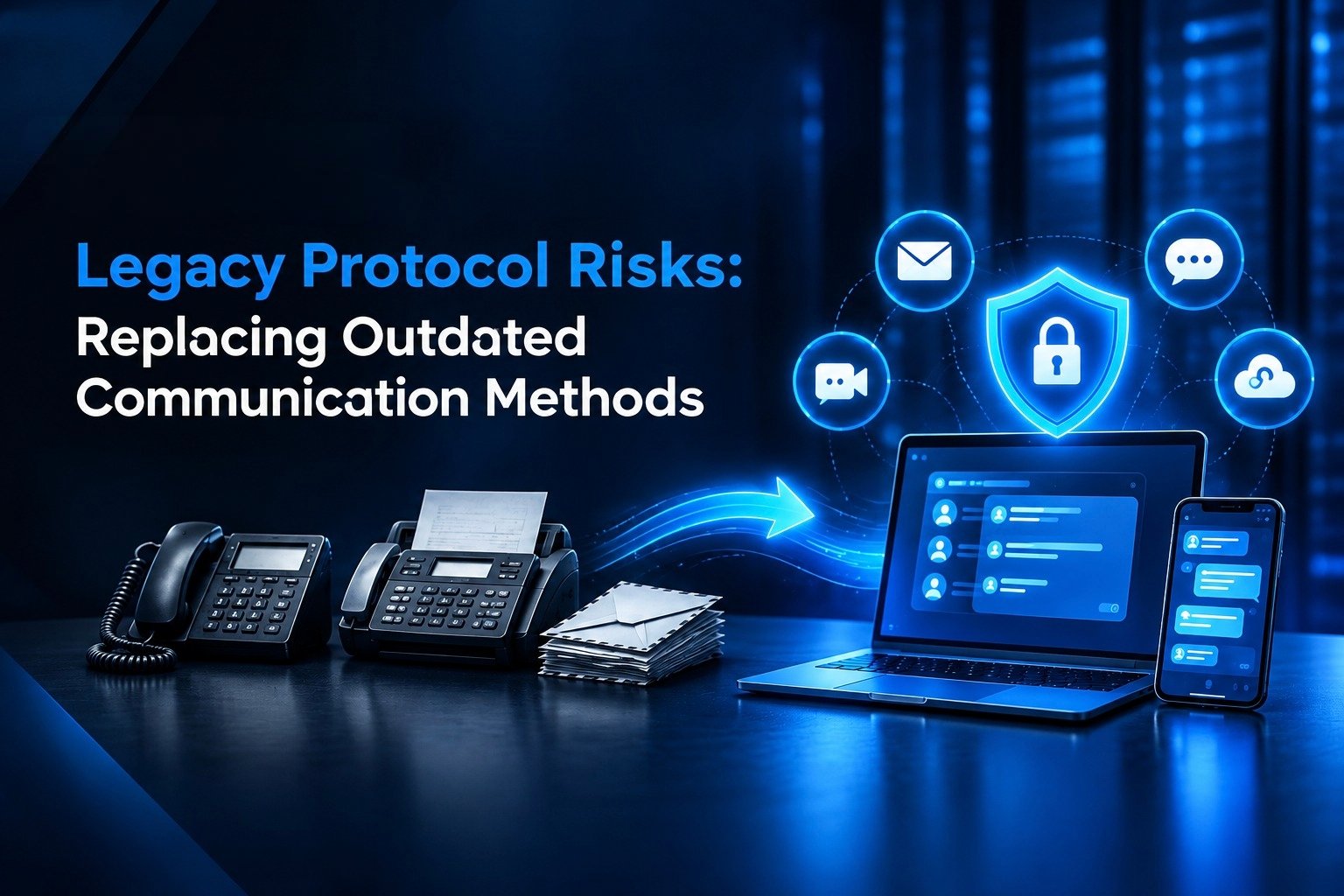
Legacy Protocol Risks: Replacing Outdated Communication Methods
Introduction
Modern businesses depend on reliable communication between applications, servers, devices, employees, and external systems. As technology evolves, however, some organizations continue to operate legacy protocols that were designed before today's cybersecurity threats became widespread.
Older communication methods may lack strong encryption, modern authentication, proper integrity checks, or adequate monitoring capabilities. Attackers can potentially exploit these weaknesses to intercept communications, gain unauthorized access, or move through connected systems.
Infrastructure modernization provides an opportunity to identify outdated protocols, assess their risks, and replace them with safer alternatives without unnecessarily disrupting business operations.
What Are Legacy Communication Protocols?
Legacy protocols are older communication methods that may still be used because they support existing applications, devices, or business processes.
Examples can include older versions of:
- File transfer protocols
- Email communication protocols
- Remote administration protocols
- Network management protocols
- Authentication mechanisms
- Database communication methods
- Internal application communication
A protocol is not automatically unsafe simply because it is old. However, protocols that no longer receive security updates or lack modern security capabilities should be reviewed carefully.
Why Legacy Protocols Create Security Risks
Legacy protocols can introduce several security challenges into modern infrastructure.
Lack of Encryption
Some older protocols transmit information without adequate encryption. Sensitive credentials, files, or business information may therefore be exposed if communications are intercepted.
Weak Authentication
Older communication methods may rely on outdated authentication mechanisms that are easier for attackers to compromise.
Poor Integrity Protection
Without effective integrity controls, attackers may be able to manipulate communications without being immediately detected.
Limited Monitoring
Modern security teams require visibility into network activity. Older protocols may provide limited logging or monitoring capabilities, making suspicious activity harder to identify.
Compatibility Constraints
Legacy systems can prevent organizations from adopting stronger security technologies because newer security controls may not be supported.
Identifying Legacy Protocols
Before replacing outdated protocols, organizations should understand where they are being used.
A protocol inventory can help identify:
- Servers using outdated communication methods
- Applications depending on legacy protocols
- Network devices using older standards
- Remote access systems
- Internal services
- Third-party integrations
- Legacy authentication mechanisms
Network traffic monitoring can help security teams identify communication patterns and determine which protocols are actively being used.
Assessing Protocol Risk
Not every legacy protocol needs to be removed immediately. Organizations should evaluate each protocol based on its security and business importance.
Important factors include:
- Whether encryption is available
- Whether strong authentication is supported
- Whether the protocol is still maintained
- What type of information it handles
- Where the protocol is used
- Whether external users can access it
- Whether a modern replacement exists
- How critical the associated system is
This risk-based approach allows organizations to prioritize high-risk protocols first.
Replacing Insecure Communication Methods
Once outdated protocols have been identified, organizations should develop a controlled modernization plan.
Replacement strategies may include:
Use Encrypted Alternatives
Organizations should prioritize protocols that provide strong encryption and secure authentication.
Restrict Access
Firewall rules, access controls, and network segmentation can limit who and what can communicate with legacy systems.
Organizations can strengthen these controls through structured network protection and monitoring. https://www.rashicore.com/networksecurity.php
Secure Network Monitoring
Replacing legacy protocols should be supported by continuous network monitoring. Security teams need visibility into communication patterns so they can identify unusual connections and unauthorized protocol usage.
Monitoring can help detect:
- Unexpected network connections
- Unauthorized services
- Suspicious traffic patterns
- Repeated authentication failures
- Unusual data transfers
- Attempts to access restricted systems
Modern network security programs can combine traffic monitoring with firewall controls, intrusion detection, secure VPN implementation, and endpoint security.
Handling Systems That Cannot Be Upgraded
Some legacy systems may be difficult or impossible to replace because they support specialized hardware or older applications.
In such cases, organizations should consider compensating controls such as:
- Network isolation
- Restricted access
- Firewall rules
- Continuous monitoring
- Strong administrative controls
- Application allowlisting
- Additional authentication controls
- Regular security assessments
The objective should be to minimize exposure while developing a long-term replacement strategy.
Conclusion
Network monitoring can identify outdated protocol usage, unusual connections, suspicious traffic patterns, and unauthorized communication between systems.
Infrastructure modernization should combine protocol replacement with network segmentation, access controls, firewalls, monitoring, and continuous security assessment.
By systematically removing obsolete communication methods, organizations can reduce attack surfaces, improve reliability, and build a more resilient technology infrastructure.
Need Professional Network Security Support?
Organizations planning to modernize legacy infrastructure can strengthen their protection through network monitoring, firewall configuration, secure VPN implementation, intrusion detection, and other network security controls.
 UK
UK
 USA
USA
 UAE
UAE
 Canada
 Australia
 Germany
 Singapore
 Netherlands