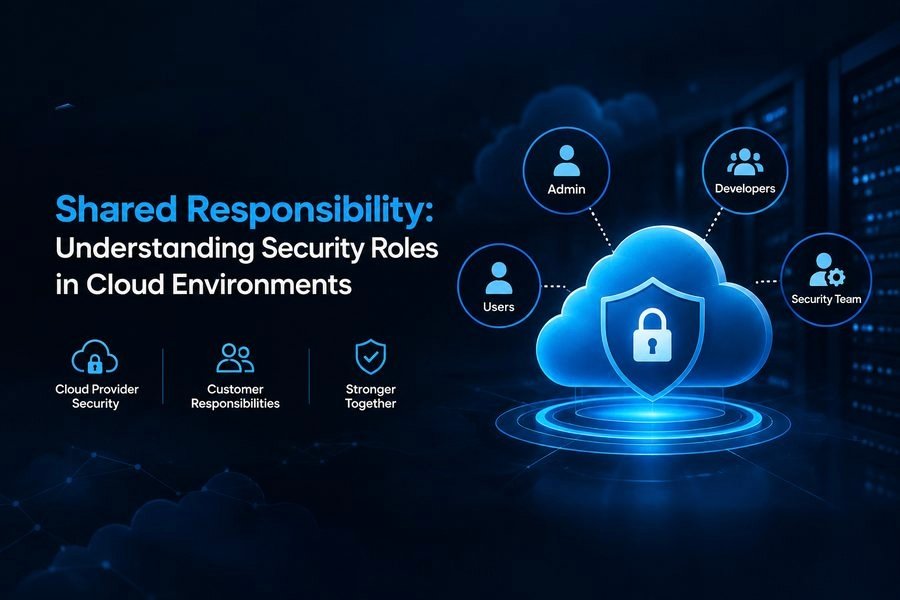
Shared Responsibility: Understanding Security Roles in Cloud Environments
Introduction
Cloud computing has transformed the way organizations store data, deploy applications, and manage business operations. However, moving workloads to the cloud does not mean that the cloud provider automatically handles every aspect of security. Organizations must understand their own security responsibilities and establish clear governance processes.
The shared responsibility model provides a framework for dividing security responsibilities between cloud service providers and their customers. While providers generally protect the underlying cloud infrastructure, customers remain responsible for securing their data, identities, configurations, applications, and workloads.
What Is the Shared Responsibility Model?
The shared responsibility model explains how security duties are distributed between a cloud service provider and the organization using its services.
The cloud provider typically manages the security of the underlying infrastructure, including physical data centers, hardware, networking foundations, and core cloud services. The customer, meanwhile, is responsible for securing what they place within the cloud.
Organizations should therefore clearly document their responsibilities before deploying critical workloads.
Why Security Roles Need to Be Clearly Defined
Unclear security responsibilities can create gaps that attackers may exploit. If an organization assumes that its cloud provider is responsible for an area that actually belongs to the customer, important security controls may be overlooked.
Clearly defined responsibilities help organizations:
- Reduce security gaps
- Improve accountability
- Strengthen compliance processes
- Protect sensitive business information
- Improve incident response
- Control access to cloud resources
- Maintain consistent security policies
A strong governance framework ensures that security ownership is understood across IT, security, compliance, and business teams.
Cloud Provider Responsibilities
Cloud providers are generally responsible for securing the infrastructure that supports their cloud services. This can include physical facilities, servers, core networking infrastructure, and other underlying components.
Providers typically implement controls such as:
- Physical data center security
- Hardware protection
- Infrastructure monitoring
- Network infrastructure security
- Platform availability controls
- Security maintenance for managed cloud services
However, organizations should not interpret provider security as complete protection of their own cloud environment.
Customer Responsibilities
Customers remain responsible for securing the resources and information they control within the cloud.
Depending on the cloud service model, responsibilities may include:
- User identity management
- Access permissions
- Data protection
- Encryption settings
- Application security
- Security configurations
- Network rules
- Backup policies
- Security monitoring
- Compliance requirements
Organizations should regularly review these responsibilities to ensure that important controls are not overlooked.
Identity and Access Management
Identity is one of the most important elements of cloud security governance. Organizations should ensure that employees, administrators, applications, and third-party users receive only the permissions they actually need.
Effective identity management can include:
- Multi-factor authentication
- Role-based access control
- Least-privilege permissions
- Privileged account management
- Regular access reviews
- Strong password policies
- Removal of inactive accounts
Organizations should also monitor privileged activities because compromised administrator accounts can provide attackers with extensive access to cloud resources.
Data Protection and Encryption
Businesses often store sensitive customer, financial, operational, and intellectual property data in cloud environments. Protecting this information should therefore be a central part of security governance.
Organizations can use encryption to protect data both during transmission and while stored. Encryption keys should also be managed carefully, with appropriate access restrictions and rotation policies.
A structured approach to cloud protection can help organizations address risks involving data exposure, unauthorized access, and cloud misconfiguration.
https://www.rashicore.com/cloud-security.php
Configuration Management
Cloud environments can change rapidly. New accounts, services, applications, storage resources, and access permissions may be created regularly.
Poor configuration can expose systems unnecessarily. Common examples include:
- Publicly accessible storage
- Excessive user permissions
- Unsecured management interfaces
- Weak authentication settings
- Unnecessary network access
- Unprotected sensitive resources
Organizations should establish configuration standards and regularly assess their cloud environments against those standards.
Conclusion
Cloud security requires cooperation between cloud providers and their customers. The shared responsibility model helps organizations understand where their responsibilities begin and where the provider's responsibilities end.
By defining ownership, controlling access, protecting data, monitoring cloud environments, reviewing configurations, and maintaining effective security governance, organizations can reduce cloud risks and build more resilient digital infrastructure.
Organizations looking to strengthen cloud risk management, identity controls, encryption, monitoring, and overall cloud protection can explore:
 UK
UK
 USA
USA
 UAE
UAE
 Canada
 Australia
 Germany
 Singapore
 Netherlands