
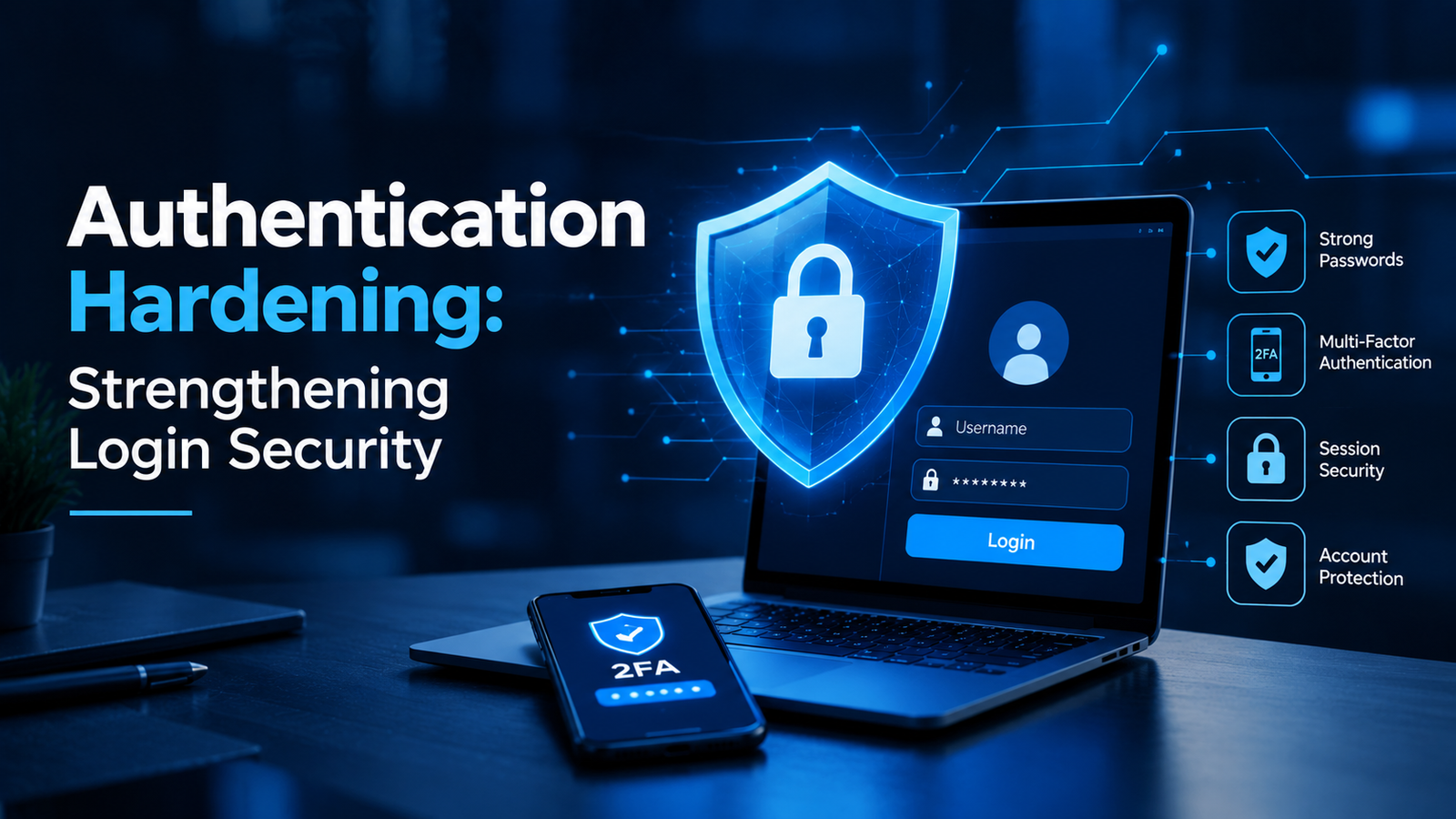
Authentication Hardening: Strengthening Login Security
Introduction
Login systems are one of the most important security boundaries of a web application. User accounts often provide access to personal information, business data, financial records, administrative functions, and other sensitive resources. If authentication mechanisms are weak, attackers may exploit stolen credentials, brute-force attacks, phishing, or other techniques to gain unauthorized access.
For organizations seeking broader protection for websites and applications, Rashicore provides Web Application Security solutions covering application security testing, source code analysis, secure SDLC implementation, and vulnerability remediation. https://www.rashicore.com/web-application-security.php
What Is Authentication Hardening?
Authentication hardening is the process of strengthening the mechanisms used to verify user identities before granting access to an application or system.
It involves more than simply creating strong passwords. A secure authentication strategy can include:
- Strong password requirements
- Multi-factor authentication
- Secure password storage
- Account lockout controls
- Login attempt monitoring
- Session security
- Secure password recovery
- Device and risk-based verification
- Protection against automated login attacks
Why Strong Authentication Matters
Attackers frequently target login pages because compromised accounts can provide direct access to valuable information and application functionality.
Weak authentication can lead to:
- Unauthorized account access
- Data exposure
- Account takeover
- Privilege abuse
- Financial fraud
- Customer information theft
- Administrative account compromise
- Business disruption
Key Authentication Hardening Practices
1. Enforce Strong Password Policies
Applications should encourage users to create strong and unique passwords. Password policies should prevent commonly used or compromised passwords and should avoid unnecessarily restrictive rules that encourage users to reuse predictable patterns.
Organizations should also consider password managers to help users maintain unique credentials across different services.
2. Implement Multi-Factor Authentication
Multi-Factor Authentication adds another verification layer beyond the password.
Depending on the application, additional factors may include:
- Authentication applications
- One-time passwords
- Security keys
- Biometrics
- Device-based verification
Even when a password is compromised, MFA can make it significantly harder for attackers to access the account.
3. Protect Passwords Securely
Passwords should never be stored in plain text. Applications should use appropriate password hashing mechanisms and secure configurations to protect stored credentials.
Database access should also be restricted so that compromised application components cannot easily expose authentication information.
4. Limit Login Attempts
Unlimited login attempts can allow attackers to repeatedly guess passwords.
Applications can reduce this risk through:
- Rate limiting
- Temporary account restrictions
- Progressive delays
- IP and device monitoring
- Bot detection
- Suspicious login alerts
These controls can help reduce brute-force and automated credential attacks.
5. Secure Login Sessions
Authentication security does not end after the user successfully logs in. Session management is equally important.
Applications should use secure session cookies, appropriate expiration periods, session invalidation, and protection against session hijacking.
Sensitive actions may also require users to authenticate again before completing the action.
6. Strengthen Password Recovery
Password reset mechanisms are often targeted by attackers. Recovery processes should verify the user's identity securely and avoid exposing sensitive information.
Password reset links should use secure, time-limited tokens and should become invalid after they have been used.
7. Monitor Suspicious Login Activity
Applications should monitor authentication events for unusual behavior.
Examples include:
- Multiple failed login attempts
- Login attempts from unusual locations
- New or unfamiliar devices
- Rapid changes in login locations
- Repeated password reset requests
- Access to accounts outside normal patterns
Monitoring these events can help security teams identify potential account compromise.
8. Protect Administrative Accounts
Administrative accounts require stronger authentication controls because they often have access to critical application functions.
Organizations should consider MFA, restricted administrative access, strong session controls, dedicated administrator accounts, and regular permission reviews.
For organizations requiring application-focused security testing and protection, Rashicore's Web Application Security services can help address vulnerabilities affecting authentication and other application components. https://www.rashicore.com/web-application-security.php
Benefits of Authentication Hardening
A strong authentication strategy can help organizations:
- Reduce account takeover risks
- Protect sensitive user information
- Limit unauthorized access
- Improve application security
- Strengthen administrative account protection
- Detect suspicious login behavior
- Support security and compliance requirements
- Increase customer confidence
Authentication should be considered as part of the application's overall security architecture rather than as an isolated login feature.
Need Stronger Web Application Protection?
Secure authentication is only one part of protecting a modern web application. Organizations should also evaluate application vulnerabilities, source code weaknesses, access controls, session management, APIs, and other security risks.
A comprehensive application security approach can help identify weaknesses early and improve the resilience of digital applications. Explore Rashicore's Web Application Security solutions for application security testing, source code analysis, secure SDLC implementation, and vulnerability remediation. https://www.rashicore.com/web-application-security.php
Conclusion
Authentication hardening plays an essential role in protecting web applications from unauthorized access and account compromise. Strong passwords, multi-factor authentication, secure sessions, login monitoring, rate limiting, and protected recovery mechanisms can significantly strengthen the authentication layer.
As cyber threats continue to evolve, organizations should regularly test and improve their authentication controls. Combining strong authentication with broader web application security practices creates a more resilient environment for protecting users, applications, and sensitive business information.
 UK
UK
 USA
USA
 UAE
UAE
 Canada
 Australia
 Germany
 Singapore
 Netherlands