
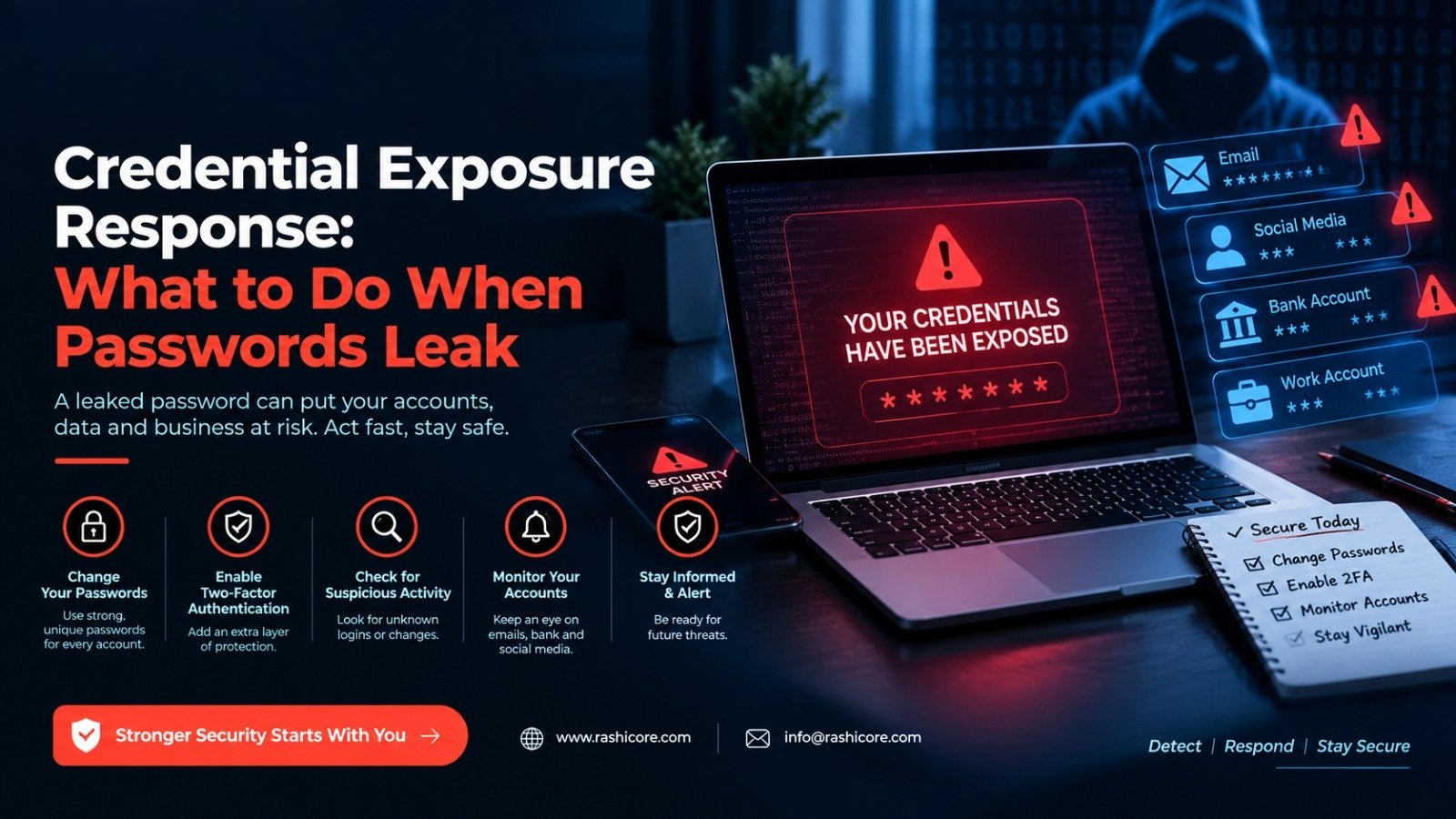
Credential Exposure Response: What to Do When Passwords Leak
Introduction
Passwords and login credentials are among the most valuable targets for cybercriminals. A credential leak can occur because of phishing attacks, malware, data breaches, weak passwords, or accidental exposure. When passwords are compromised, attackers may gain unauthorized access to business systems, customer data, applications, and other critical resources.
A fast and effective credential exposure response is essential for reducing the impact of a security incident. Organizations should have proper processes in place to identify compromised accounts, secure access, and prevent further misuse.
https://www.rashicore.com/itsoftware.php
Understanding Credential Exposure
Credential exposure happens when usernames, passwords, API credentials, or other authentication information become accessible to unauthorized individuals. Even a single compromised password can create serious security risks, especially when the same password is used across multiple systems.
Attackers may use stolen credentials to access email accounts, cloud platforms, business applications, and sensitive databases. For this reason, organizations must respond quickly when credential exposure is discovered.
What to Do When Passwords Leak
1. Change Compromised Passwords Immediately
The first step is to reset passwords for all affected accounts. Passwords should be replaced with strong and unique credentials that are not used on other platforms or systems.
2. Revoke Active Sessions and Access
Changing a password alone may not always be enough. Organizations should revoke active login sessions, authentication tokens, and unauthorized access to ensure attackers cannot continue using an existing session.
3. Enable Multi-Factor Authentication
Multi-Factor Authentication (MFA) provides an additional layer of protection. Even if a password is stolen, MFA can help prevent attackers from accessing an account without additional verification.
For organizations looking to strengthen their IT and software security approach, visit:
https://www.rashicore.com/itsoftware.php
4. Investigate the Source of the Exposure
Businesses should determine how the credentials were exposed. This may involve reviewing phishing attempts, malware activity, application vulnerabilities, employee access, or third-party security incidents.
Understanding the source helps organizations prevent similar incidents in the future.
5. Monitor for Suspicious Activity
Security teams should monitor affected accounts and systems for unusual login attempts, unauthorized access, and unexpected changes. Early detection can help reduce the impact of a compromised credential.
6. Educate Employees About Credential Security
Employees play an important role in protecting organizational credentials. Regular awareness training can help users recognize phishing attacks, avoid sharing passwords, and follow secure authentication practices.
Building a Strong Credential Security Strategy
Credential exposure response should be part of a broader cybersecurity strategy. Organizations can improve protection by implementing strong password policies, MFA, access controls, regular security monitoring, and employee awareness programs.
A proactive IT and software security approach can help businesses identify and reduce potential risks before compromised credentials lead to a major security incident.
https://www.rashicore.com/itsoftware.php
Conclusion
A password leak can quickly become a serious cybersecurity incident if it is not handled properly. Organizations should immediately reset compromised passwords, revoke unauthorized sessions, investigate the source of exposure, and monitor affected systems.
By developing a strong credential security strategy and responding quickly to password leaks, businesses can reduce the risk of unauthorized access and protect their critical digital assets.
 UK
UK
 USA
USA
 UAE
UAE
 Canada
 Australia
 Germany
 Singapore
 Netherlands