
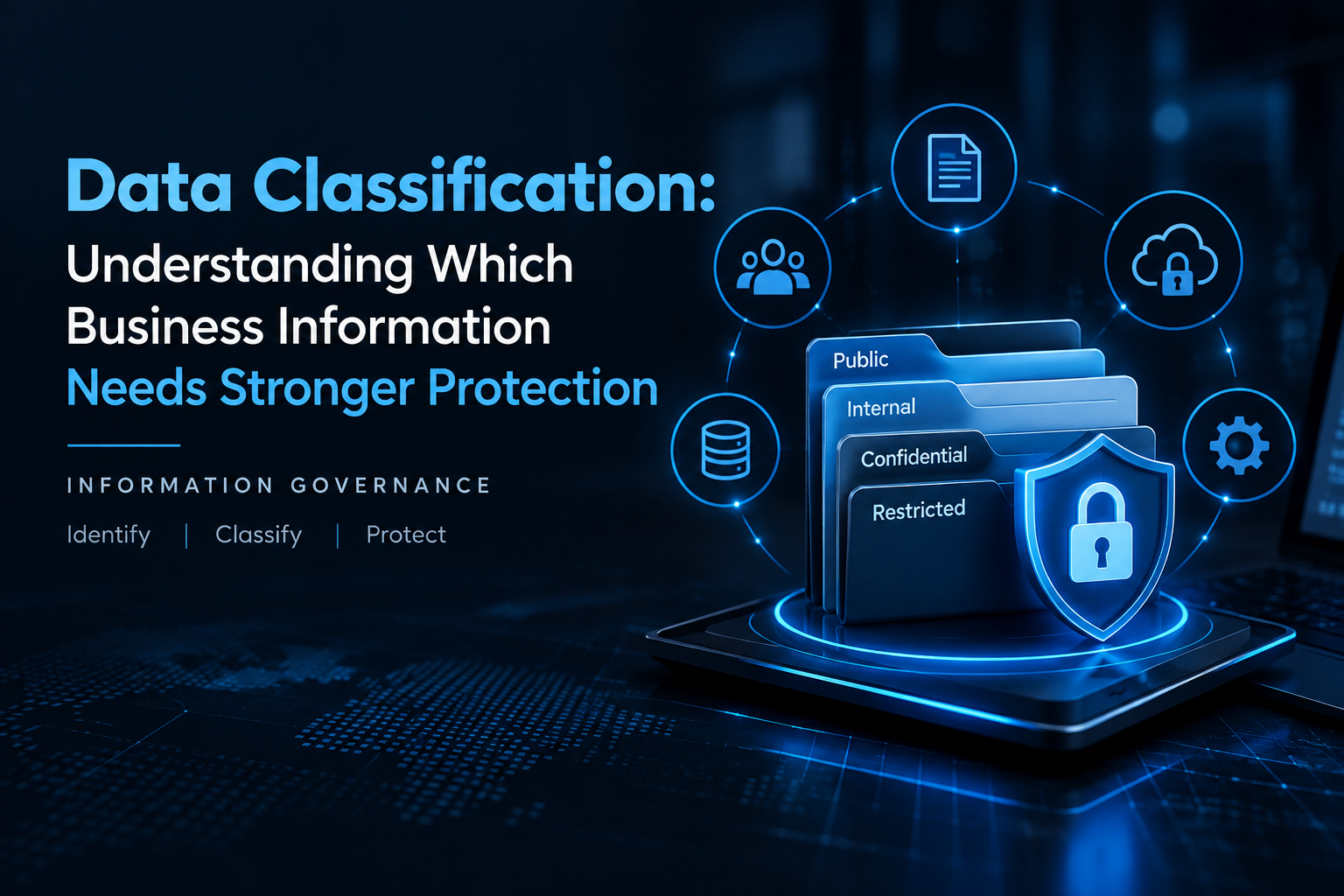
Data Classification: Understanding Which Business Information Needs Stronger Protection
Introduction
Businesses handle different types of information every day, including customer details, financial records, employee data, business plans, and internal documents. While some information can be shared publicly, other data needs stronger protection to prevent unauthorized access, misuse, or accidental disclosure.
Data classification helps organizations identify how sensitive their information is and decide which security measures are needed. It also supports better information governance by making data easier to manage, monitor, and protect.
1. What Is Data Classification?
Data classification is the process of organizing information into categories according to its sensitivity, importance, and business or legal requirements. Each category has different rules for storing, sharing, accessing, and protecting information.
For example, a public company brochure does not need the same level of protection as customer payment details or confidential business agreements.
A clear classification system helps employees understand how information should be handled and reduces confusion about which data requires additional security.
2. Identify the Different Types of Business Information
Before applying security controls, businesses need to understand what information they collect, create, and store. Common types of business information include:
- Public information: Website content, published reports, product descriptions, and approved marketing materials.
- Internal information: Internal procedures, routine project documents, and employee communications not intended for public release.
- Confidential information: Customer lists, business strategies, financial reports, supplier contracts, and non-public commercial information.
- Restricted information: Highly sensitive personal records, payment information, account credentials, and other data requiring tightly controlled access.
These categories are examples rather than universal labels. Every organization should define its classification levels according to its business needs, risk exposure, and applicable requirements.
3. Understand Which Information Needs Stronger Protection
Not all information creates the same level of risk when exposed. Businesses should consider the possible consequences of unauthorized access, alteration, loss, or disclosure.
Customer information may create privacy concerns, while leaked financial records could lead to fraud or financial damage. Unreleased business plans may affect competitiveness, and exposed login credentials could allow attackers to access company systems.
Organizations should give greater attention to information that could cause serious harm if compromised. This helps them prioritize security resources and apply suitable controls.
For guidance on protecting important business information, explore https://www.rashicore.com/data-protection.php.
4. Create Clear Classification Policies
A data classification policy explains how employees should identify and handle different types of information. It should define each classification level, provide examples, and describe the required security measures.
A useful policy should explain:
- Which information belongs to each category
- Who is authorized to access specific information
- How sensitive files should be stored and shared
- When encryption or additional approval is required
- How long information should be retained
- How information should be securely deleted when no longer needed
Clear guidelines make it easier for employees to follow consistent practices across departments and reduce the risk of accidental data exposure.
5. Apply Access Controls Based on Data Sensitivity
Access to sensitive information should be limited to people who need it for their work. Giving every employee unrestricted access can increase the risk of accidental disclosure and misuse.
Businesses can use role-based access controls to assign permissions according to job responsibilities. Multi-factor authentication can provide an additional layer of security, while access reviews help identify unnecessary permissions.
For highly sensitive information, organizations should also maintain access logs and review unusual activity. These measures help ensure that data is available to authorized users without making it unnecessarily accessible to others.
6. Protect Data Wherever It Is Stored or Shared
Business information may exist in email accounts, cloud platforms, databases, shared folders, laptops, and physical documents. Classification should cover these different locations rather than focusing only on one system.
Depending on the sensitivity of the information, businesses may need to use encryption, secure file-sharing methods, protected backups, and restrictions on downloading or copying files.
Employees should also avoid sharing confidential information through unapproved applications or personal accounts. Reviewing how data moves between departments, external partners, and cloud services can reveal gaps that require attention.
Learn more about data security and protection measures at https://www.rashicore.com/data-protection.php.
7. Train Employees to Handle Sensitive Information
Even well-designed security systems can be weakened by human mistakes. Employees may accidentally send a confidential file to the wrong person, use an unsafe sharing method, or store sensitive documents in an unsuitable location.
Regular training helps staff recognize different data categories and understand the correct handling procedures. Practical examples can demonstrate how to label documents, verify recipients, report suspicious activity, and safely dispose of information.
Training should be relevant to employees' daily responsibilities. Staff who regularly handle financial or customer records may require more specific guidance than employees who work mainly with public information.
8. Review and Update Data Classifications Regularly
The sensitivity of information can change over time. A business plan may become public after an announcement, while a routine document may become confidential when combined with customer details or financial information.
Organizations should periodically review their data inventories, classification labels, access permissions, and retention policies. New applications, business partnerships, regulatory changes, and security incidents may also require updates.
Automated discovery and classification tools can help identify sensitive information across large environments. However, human review remains important when the context or business impact is unclear.
9. Common Data Classification Mistakes to Avoid
Businesses may face unnecessary risks when their classification practices are inconsistent or outdated. Common mistakes include:
- Treating all information as equally sensitive
- Leaving confidential files without clear labels
- Giving employees more access than they need
- Ignoring information stored in backups or shared folders
- Using unclear policies that employees cannot easily follow
- Failing to review classifications after business changes
- Relying entirely on automated tools without checking results
Avoiding these mistakes helps organizations apply more appropriate protection and maintain better control over their information.
10. How Data Classification Supports Information Governance
Information governance establishes how an organization manages information throughout its lifecycle. Data classification supports this process by helping businesses decide who can access information, where it should be stored, how long it should be retained, and when it should be securely deleted.
When classification is combined with access controls, monitoring, employee training, and regular reviews, organizations can manage sensitive information more consistently. It also helps security teams focus on the information that presents the greatest potential risk.
For additional information about business data protection, visit https://www.rashicore.com/data-protection.php.
Conclusion
Data classification is an important part of protecting business information and maintaining effective information governance. By identifying sensitive records, defining clear policies, limiting access, and reviewing classifications regularly, organizations can make better security decisions.
The most effective approach combines suitable technology with clear procedures and employee awareness. Businesses that understand which information needs stronger protection are better prepared to reduce risks and manage their data responsibly.
To learn more about protecting sensitive business information, visit https://www.rashicore.com/data-protection.php and explore the available data protection services.
 UK
 USA
 UAE
 Canada
 Australia
 Germany
 Singapore
 Netherlands